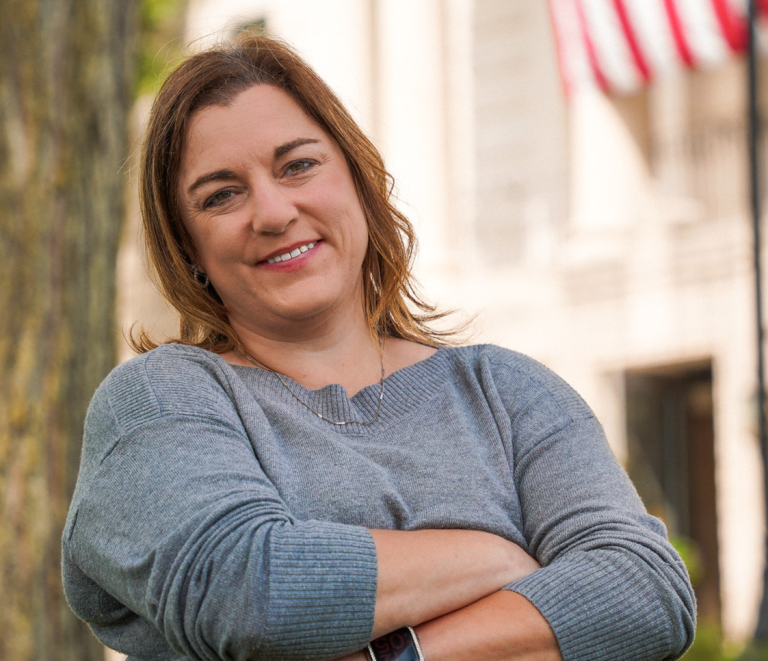

Bone fragments, teeth and scattered belongings are often all that is left of disappeared people in the desert of northern Mexico, according to journalist and author Dawn Paley. Paley visited the University of Indianapolis on
Thursday, April 12 to discuss her involvement volunteering in the north of Mexico with Grupo Vida, dedicated to exhuming and identifying skeletal human remains found in the desert.
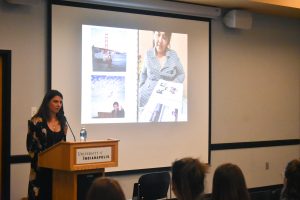
“Grupo Vida has managed to make what was a very heavy individual burden on each individual family into a collective effort,” Paley said. “And they are leading the way in a nationwide push by family members to find the disappeared.”
Grupo Vida is comprised mainly of family members of missing persons. Trained as a journalist, Paley has also begun work with the group and accompanies them on their Saturday morning travels into the desert to search for the remains of missing people. They search for bone fragments and other identifiable remains around Puebla, Mexico in hopes of matching the genetic profile to one of the thousands of people that are missing in
Mexico.
Paley presented her own theories about the socioeconomic and political factors that accompany mass disappearances in Mexico and shared the stories of victims and survivors.
Paley is originally from British Columbia, Canada, but is currently completing a Ph.D at the Autonomous University of Puebla. According to Paley, the majority of searches being conducted for missing persons in Mexico are by civilians, not law enforcement.
“There are currently at least five collectives of parents, family members and friends of people who have been disappeared conducting searches in different parts of Mexico,” Paley said. “I want to emphasize the state, the government, the police, no one is looking for the disappeared in Mexico except for the family members. No one else.”
The primary focus of Paley’s speech and accompanying presentation was how the problem of mass disappearance in Mexico grew to such an extent, and the factors that perpetuate it. For example, she explained how the war on drugs in Mexico, declared by former Mexican President Felipe Calderón in December 2006, contributes to violence along the border by creating a hostile atmosphere and encouraging cartels and other criminal organizations to militarize in order to protect their operations.
“The crucial thing to keep in mind is that what is happening in Mexico is not a war on drugs, it’s war on the people of Mexico,
Paley said. “The people being killed in this war are workers, they’re migrants, they’re students.”
Paley also pointed out that the United States has a vested interest in allowing “the paramilitarization of migration” because it is beneficial to American foreign policy to deter migrants from crossing into the United States, even if doing so means subjecting the Mexican public to further terrorization.
“You have essentially organized crime groups like Los Zetas actually hunting migrants, gathering them up, detaining them, sometimes killing them, and dissuading people from trying to migrate from Central
America or from Mexico up to the U.S.,” Paley said. “[They are] essentially carrying out a US border policy in a kind of unofficial way. What we notice is that in these kind of crimes against migrants in Mexico by criminal groups, who often work together with the state, there is almost total impunity for the perpetrators.”
According to Paley, the lack of persecution for disappearances make the Mexican state complicit in the violence in Mexico. This was shocking to junior international relations major Halle Risinger, who said that she had not realized the extent of the situation in Mexico or the involvement of law enforcement and political entities in the disappearances.
“I found her information about how widespread people disappearing is in Mexico. I knew the situation was bad but not to that extent,” Risinger said. “I was also surprised to hear that politicians and corporations are contributing to the disappearances of Mexicans and other Latinos traveling through
Mexico and that they aren’t sure why this is happening.”
Paley was invited to campus by the UIndy Forensics Club, who met her at a conference where Associate Professor of Biology and Anthropology and
Director of the Human Identification Center Krista Latham was in attendance. According to Latham, the students chose to contact Paley because of her youth and relatability as a student.
“Most of my students were at that conference, and they heard her and they met her and they thought that it would be great to bring her up here for a variety of reasons,” Latham said. “First, she’s doing really important work, but they instantly connected with her because she’s young…..They were just really
inspired by her and thought that she had a great story, she had great experiences, and that it would be really motivating to bring her up here to speak to UIndy. So they did all of that work to get her up here.”
Latham herself has done extensive work along the southern border of the United States and has taken groups of students to Texas for years to exhume the bodies of informally buried migrants that perish in the desert. According to Latham, awareness, even among college students, is the first step towards concrete policy change. Sophomore elementary education major Sophia
Frieden said that she is optimistic about the impact Paley’s work will have in increasing awareness about the crisis in Mexico.
“Before attending this event I was unaware of the extent to which these ‘disappearings’ were happening,”
Frieden said. “This lecture was a great opportunity to learn about a humanitarian crisis that does not get much attention in the media. Going forward, I hope this issue receives more attention globally.”
image sources
- Dawn_Dawn-Paley-Event_April_12: Photo by Gysai Durgans