
The American people have joked about Congress’s lack of productivity for the better part of a century, according to Britannica, but, as the old proverb goes, “Many a true word is spoken in jest.”
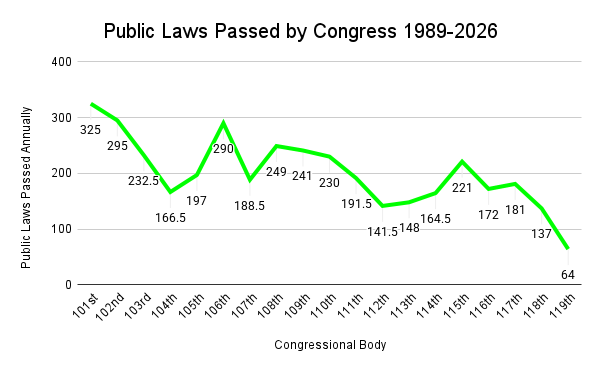
The satirical characterization of our federal representatives as the “Do-Nothings” has sadly become representative of the reality in which we find ourselves. The 119th Congress has passed laws at the lowest rate in over 35 years, according to congressional records, and presided over the two longest government shutdowns in U.S. history, according to NBC.
However, this dysfunction is not something that can be blamed on one candidate, one party or even one congressional body. Rather, it is a reflection of the slow and insidious divide that has been progressively widening between the two sides of the political spectrum.
The degree of polarization that has permeated our politics has shackled our democracy, which is made evident by the fact that our representatives are more interested in assigning winners and losers than pursuing policy solutions to our most pressing issues. The current partial government shutdown demonstrates this perfectly, as both parties desperately try to assign blame to the other side. As a result, their constituents suffer, and their pleas for relief fall upon deaf ears.
This is the predictable result of a political environment that has weaponized disagreement, which itself is not detrimental to our democracy; but, it is predicated upon it. What has changed is the nature of our disagreements. Lawmakers no longer debate the best path forward, rather they argue whether the other side has the right to exist.
This sort of “no-holds-barred” approach to politics threatens the very foundations of our republic that were set in place over 200 years ago. Joe Manchin, a former Independent senator from West Virginia, argues this exact point in his book “Dead Center,” which details over a decade of his experience as a member of Congress.
“I’ve lived the reality of the deepening divide between Democrats and Republicans paralyzing Washington—turning governance into gridlock, eroding trust in our institutions [and] making genuine compromise nearly impossible,” Machin writes. “The consequences of this dysfunction aren’t just infuriating; they are reckless. When politics becomes a zero-sum game, democracy itself is at risk.”
However, we cannot assign the entirety of the blame to our elected officials. Ultimately, they are a reflection of ourselves. If we wish to see change, we must embody it – not only demanding better of our representatives, but also of each other and ourselves.
We are capable of so much more than we realize when we treat our fellow citizens with respect and dignity, endeavoring to understand the differences we may have rather than allowing them to divide us. As Martin Luther King Jr. said, “Darkness cannot drive out darkness; only light can do that. Hate cannot drive out hate; only love can do that.”