
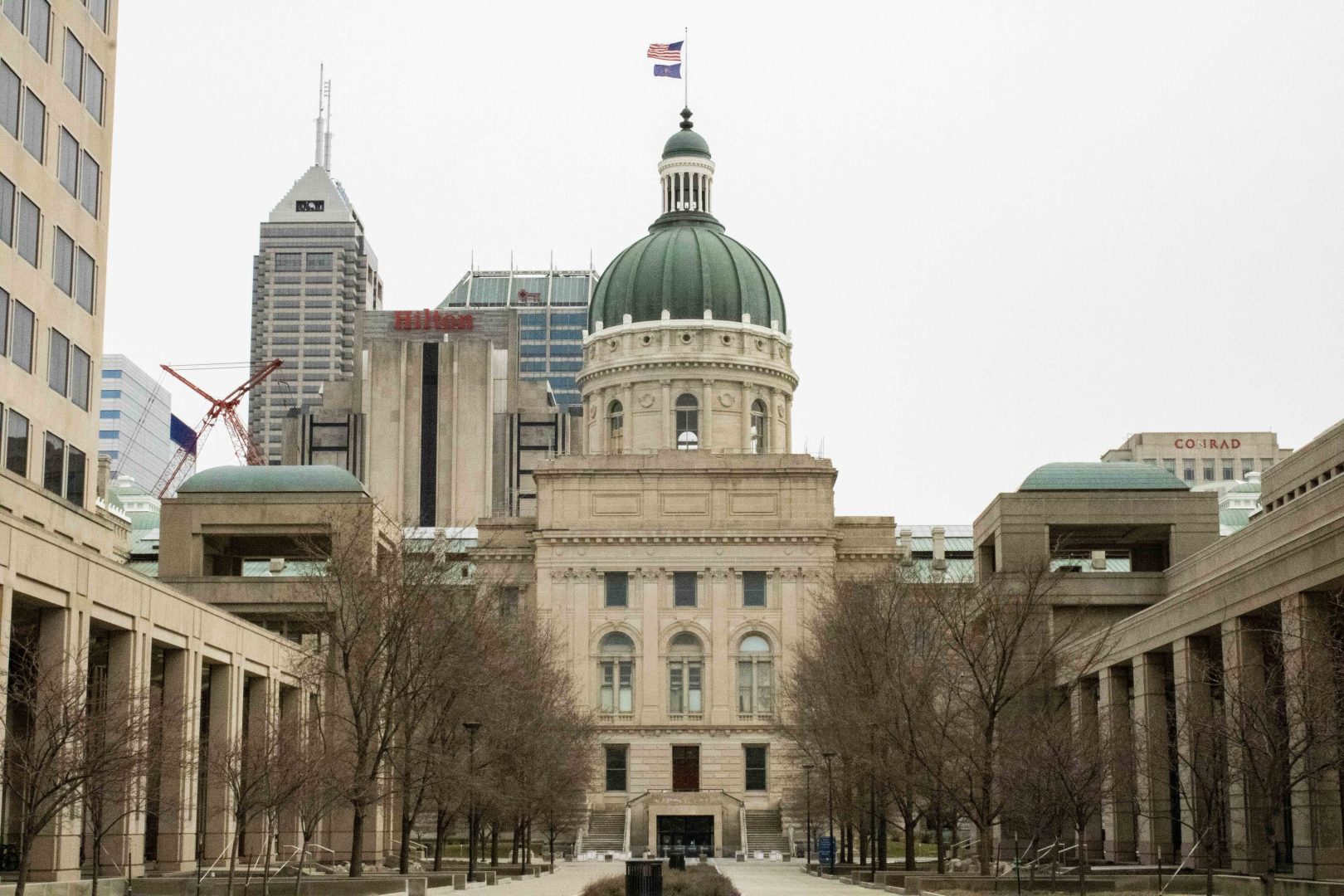
As of Feb. 25, the Indiana Senate passed the amended version of Senate Bill 76, titled “Immigration Matters,” with a 37-11 vote, sending the bill to Governor Mike Braun’s desk.
University of Indianapolis Assistant Professor of Philosophy Lacey Davidson said there is already a state law in place that prohibits the restriction of federal immigration law enforcement. Therefore, SB 76 is revising a specific part of the code. The two main changes, according to Davidson, are: (1) enforcement has broadened to all levels, including federal, state and local law enforcement; and (2) there is now a $10,000 civil penalty for universities that knowingly or intentionally refuse to comply. Additionally, the bill includes cooperation agreements between the US Immigration and Customs Enforcement and state and local police, which Davidson said strengthens their cooperation.
This bill does not do enough to protect citizens against immigration enforcement, according to Davidson. Because it is such a proactive enforcement mechanism, there will be many citizens who are subject to immigration enforcement practices that should not be.
Davidson said she believes the code changes could apply to either a public or private university, specifically referring to the civil penalties, since UIndy’s police department is “governed by the same rules as all other police departments in the state of Indiana.” The bill also states that it applies to “a governmental body or postsecondary educational institution,” which Davidson said UIndy falls under the latter. She said even if the code does not particularly affect UIndy’s governance structure, an enforcement mechanism could be placed on a private institution if the government decides not to fund the university for grants or student loans.
“…Another thing it adds is if you are wrongfully involved in an immigration enforcement process, like you’re a citizen or have appropriate documentation, you can’t sue,” Davidson said. “You can’t say ‘I was wrongfully detained.’ I’m not talking about what I think we owe each other as human beings, but if we’re just going from the civil liberties aspect, it will impose on liberties to not be searched and seized, which is a huge problem.”
This bill could restrict people’s movement ability, whether or not they have citizenship status, a working visa, a student visa or those who do not have status to live or work in the United States, according to Davidson. She said this also affects people’s ability to seek “basic help” or “contribute to our societies.”
People are here in the US because they have refugee status, asylum status and have fled violence, either war, gender-based violence, or religious or political persecution, according to Davidson. She said those people may not have a way to get status any other way, except via asylum.
“Even if you believe that immigration enforcement is justifiable, I think at certain times, you still have to be concerned about how it’s done and that people’s human rights are not violated in that process,” Davidson said.
UIndy Associate Professor of Political Science Greg Shufeldt said public opinion polls are showing that most people feel ICE and the current immigration policies are going too far, resulting in a “climate of fear.” Due to most Americans not knowing the ins and outs of what is happening at the Indiana General Assembly and in Congress, people do not always necessarily know what their rights are or what legislation does, according to Shufeldt. He added that the system of federalism, the division of power between the federal government and states, has created some confusion because immigration has historically been controlled by the federal government.
Although Davidson feels the code changes apply to both public and private institutions when referring to the civil penalties, as aforementioned, Shufeldt said he believes this legislation is more focused on public universities.
“For students at IU Indianapolis or Bloomington…, this [code change] perhaps diminishes some of the rights, freedoms or protections students might have thought that they had,” Shufeldt said. “At a private school [like UIndy], we are a little bit insulated from some of the things in Senate Bill 76, but it is certainly, I think, a word to use appropriately in quotes would be ‘chilling,’ and this sort of legislation certainly creates a climate of uncertainty for how people think it might be implemented.”
UIndy Police sent out an email on Feb. 9, titled “Information and Resources Regarding Immigration.” The beginning of the email states, “This is not being shared in response to, or in anticipation of, any immigration enforcement action on campus. Our goal is to ensure our community has access to accurate information and understands available resources and procedures.”
The email states “to contact UIndy Chief of Police Brandon Pate and to notify Cyndi Carrasco in the General Counsel’s Office in the event that Immigration and Customs Enforcement (ICE) or the Department of Homeland Security (DHS) arrives on campus to serve a warrant.”
Carrasco is “…the head lawyer for UIndy and is also a sitting [Republican] Indiana State Senator who voted in favor of this legislation,” Shufeldt said. Similarly, Davidson said she does not think a student would have good reasons to contact either Pate or Carrasco in a situation where ICE or DHS were to show up. ICE and the Indiana State Police have an agreement already “on the books” from this past summer to work collaboratively, and “you have somebody [Carrasco] who is in support of a bill [SB 76] that is putting in place the sort of architecture, support and sort of like the legal code for how this is going to be done,” according to Davidson. Pate said he can only speak to Carrasco’s position as the General Council at UIndy, who makes sure all legal aspects and processes are followed correctly.
The email leaves questions about the doors that are unlocked for ADA accessibility, and it does not clarify whether ICE would then need permission to enter those doors. Additionally, the email does not include whether or not resident assistants (RAs) in dormitory halls are (1) being trained on how to handle this type of scenario and (2) if RAs can determine whether or not ICE or DHS needs permission to enter a building.
The Reflector requested phone interviews with Carrasco and Pate. Carrasco declined a phone interview and asked for questions via email instead.
“Any door that is unlocked, whether propped open or left open for ADA, would be accessible by any law enforcement officer of any agency, as well as the public,” Pate said.
When asked whether RAs are being trained on how to respond, Pate replied, “They’re being told to use the email that we sent out that says to contact the police department or General Counsel if they come in contact with any law enforcement agent presenting any type of warrant, be it administrative or legal.”
The Reflector asked Pate whether UIndy students would feel comfortable and safe or not notifying Carrasco, if they were aware of her political affiliation and voting history, and he responded with, “I don’t have an answer for that.”
The Reflector spoke to an RA on campus to ask if they are being trained in case ICE or DHS were to show up on campus. The RA said it is university policy not to disclose any information as an RA, not just regarding ICE.